道ジュネーが終わると、いよいよ大綱引きの本番が始まる。
道の中央に巨大な綱が据えられ、北と南、それぞれの綱が結び合わされて一本の大綱になる。
そして町の人々がその綱を引き合うとき、この行事のクライマックスが訪れる。
After the Michijunē comes to an end, the main event of the Great Tug-of-War finally begins.
A massive rope is laid out at the center of the road, where the northern and southern ropes are joined together to form a single, enormous rope.
And when the people of the town begin to pull against each other, the climax of the event unfolds.
本文
まず、道の端に寄せられていた綱が、ゆっくりと道の中央へと運ばれていった。
実行委員会の人たちの指示のもと、綱の位置が少しずつ調整されていく。
この綱は二本の綱からできている。
雄綱と雌綱である。
それぞれの綱には大きな輪があり、その輪同士を重ね合わせて一つの綱にする。
しかし、この位置を合わせる作業は簡単ではない。
巨大で重たい綱を、引き手の人たちの力を借りながら少しずつ動かしていく。行き過ぎれば戻し、また少し引き、微妙な調整を繰り返していく。ほんのわずかな違いが全体に影響するため、慎重な作業が続いた。
まるで長年の経験を積んだ職人が仕事をしているような、そんな緊張感のある時間だった。
輪の位置がぴたりと重なると、今度はその輪が外れないように「カヌチ棒」が差し込まれる。
その棒は、第2章で書いたように、嘉手志川の水の中から引き上げられる様子を撮影していた、あの棒である。
川の中で磨かれていた棒が、いま巨大な綱をつなぐ役目を果たそうとしている。
近くにいると危険だということで、私は少し離れた場所から撮影していたため、棒が差し込まれる瞬間そのものは撮れなかったが、カヌチ棒によってしっかりと結ばれた綱の姿を撮ることはできた。
こうして北と南の綱は一本の大綱になる。
綱が結ばれると、次に儀礼のような場面が始まった。
片方からは、刀を持った男性二人が神輿のようなものに乗せられ、綱の上を運ばれてくる。
もう片方からは、船を漕ぐ道具を持った人たちが同じように神輿に乗せられて運ばれてくる。
二つの神輿は綱の中央で向かい合い、互いに戦うような所作を見せる。
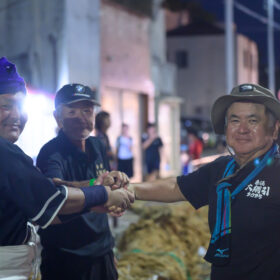
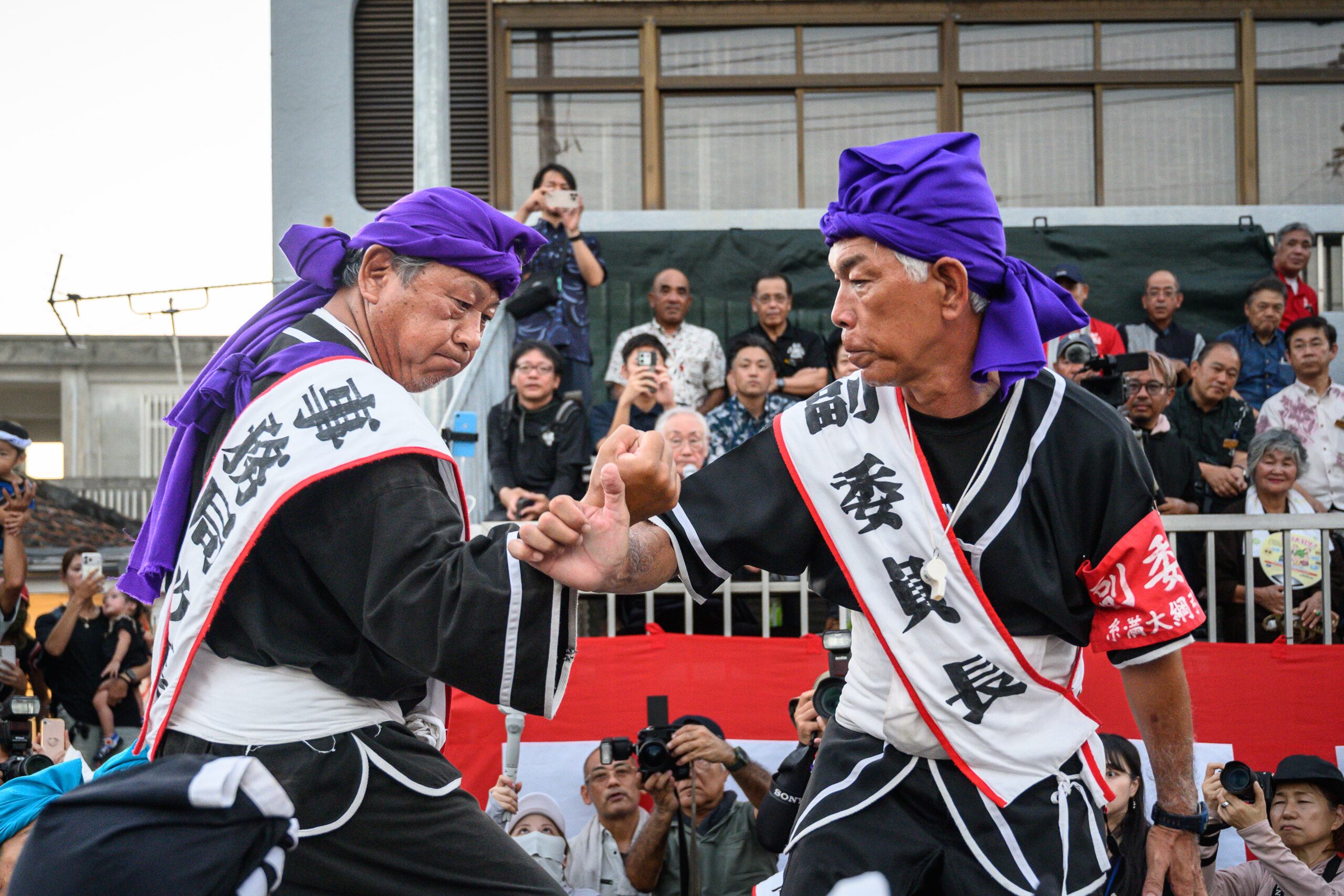
その後、実行委員会の副委員長と事務局長が綱の中央に立ち、腕を組み合うような力比べを行う。
そして最後には互いに握手を交わし、健闘を称え合う。
そして実行委員長の合図によって、いよいよ綱引きが始まる。
この大綱引きは、私たちがよく知っている綱引きとは少し違っていた。
ずっと引き続けるわけではない。
引く。
そして休む。
また引く。
そのタイミングを見ながら、戦略的に綱を引き合う。
勝敗が決まるまでには、30分以上かかることもあるという。
休むときには、相手に綱を引かれないように、人々が綱の上に座り込む。
何十人もの人が綱の上に並んで座り、綱が動かないようにしている光景は、なかなか見たことのないものだった。
いつ引くのか。
いつ休むのか。
その判断を指示しているのが、実行委員会の人や青年会の人たちだった。
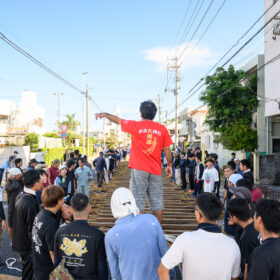
彼らは綱の上に立ち、声を張り上げながら合図を送る。
その表情はとても真剣で、そしてどこか誇らしげでもあった。
綱を引いている人たちは、それぞれ自分の地域の側につき、北なら北、南なら南の綱を引く。
もちろん勝てば嬉しい。
その年の豊穣を占う意味もあると言われている。
けれど綱を引いている人たちの表情を見ると、勝敗以上に、この時間そのものを楽しんでいるようにも見えた。
ただ、実行委員会の人たちの表情は少し違っていた。
勝った側は本当に嬉しそうで、負けた側は悔しそうだった。
長い時間をかけてこの行事を準備してきた人たちだからこそ、その思いの強さが表情に表れているのだろうと思った。
やがて合図とともに、綱が大きく引かれる。
巨大な綱が大きく動いた瞬間、歓声が上がり、人々の声が一斉に重なった。
町全体が、その一本の綱に力を込めているようだった。
写真-PHOTOS-


ちょっと危ないから離れたほうがいいね。


南方の指揮を取っていた人にピーズサインが喜びを物語っている。

注記
本作品は、糸満大綱引きという地域文化の記録および文化継承の一助となることを願い、制作しています。
撮影は糸満大綱引き実行委員会関係者のご理解と許可をいただいたうえで行っています。
写真の掲載について、もし不都合や問題等がございましたら、速やかに対応いたしますので、ご連絡いただけますと幸いです。
(info@yoshihiro-hirose.org)
本作品の無断転載・複製はご遠慮ください。
ENGLISH
At first, the rope that had been set aside at the edge of the road was slowly carried toward the center.
Under the direction of the organizing committee, its position was gradually adjusted.
This rope is made from two separate ropes — a male rope and a female rope.
Each rope has a large loop at its end, and these loops are overlapped to form a single rope.
However, aligning them is not an easy task.
The massive, heavy ropes are moved little by little with the help of the pullers. If they go too far, they are pulled back, then adjusted again — repeating this delicate process over and over. Even the slightest misalignment affects the whole, so the work continues with great care.
It was a tense moment, almost like watching a master craftsman at work.
When the loops finally align perfectly, a wooden pin called a kanuchi-bō is driven through them to secure the connection.
This is the same pole I had photographed earlier, being pulled up from the waters of the Kadeshigawa River, as mentioned in Chapter 2.
A piece of wood that had been shaped by the river is now taking on the role of binding this enormous rope together.
Because it was considered dangerous to stand too close, I was shooting from a slight distance, and I couldn’t capture the exact moment the pin was inserted. But I was able to photograph the rope firmly bound together by the kanuchi-bō.
In this way, the northern and southern ropes become one.
Once the rope is joined, a ritual-like scene begins.
From one side, two men holding swords are carried on something like a portable shrine, moving along the top of the rope. From the other side, people carrying boat oars are brought in the same way.
The two groups face each other at the center of the rope, performing movements as if they are about to engage in combat.
After that, the vice chairman and the secretary-general of the organizing committee step onto the rope and engage in a symbolic test of strength, locking arms. In the end, they shake hands, honoring each other’s efforts.
Then, with a signal from the chairman, the tug-of-war finally begins.
This tug-of-war is a little different from the kind most of us are familiar with.
It is not a continuous pull.
They pull. Then they rest. Then they pull again.
Watching the timing carefully, they engage in a strategic back-and-forth.
It can take more than 30 minutes before a winner is decided.
When they rest, people sit on top of the rope to prevent the other side from pulling it. Dozens of people lined up along the rope, sitting on it to hold it in place — it was a sight I had never seen before.
When to pull. When to rest.
These decisions are directed by members of the organizing committee and the youth groups.
They stand on the rope, shouting instructions, their expressions intense, yet somewhere also proud.
The people pulling the rope stand on the side of their own community — north pulls for the north, south for the south.
Of course, winning brings joy. It is also said to foretell the year’s harvest.
But looking at their faces, it seemed that more than winning or losing, they were enjoying the moment itself.
The expressions of the organizers, however, were different.
Those on the winning side looked genuinely delighted, while those on the losing side showed clear frustration.
Having spent so much time preparing for this event, their emotions seemed to surface directly on their faces.
Then, with a signal, the rope is pulled with force.
The moment the massive rope shifts, a roar rises, and voices overlap all at once.
It felt as if the entire town was pouring its strength into that single rope.
—
Other articles in this series can be found in the magazine.
For activities and profile:
https://yoshihiro-hirose.org
—
All photographs and texts published here are copyrighted by the photographer.
Unauthorized reproduction, duplication, or use is strictly prohibited.
If there are any concerns regarding the publication of photographs, please feel free to contact me and I will respond promptly.
info@yoshihiro-hirose.org