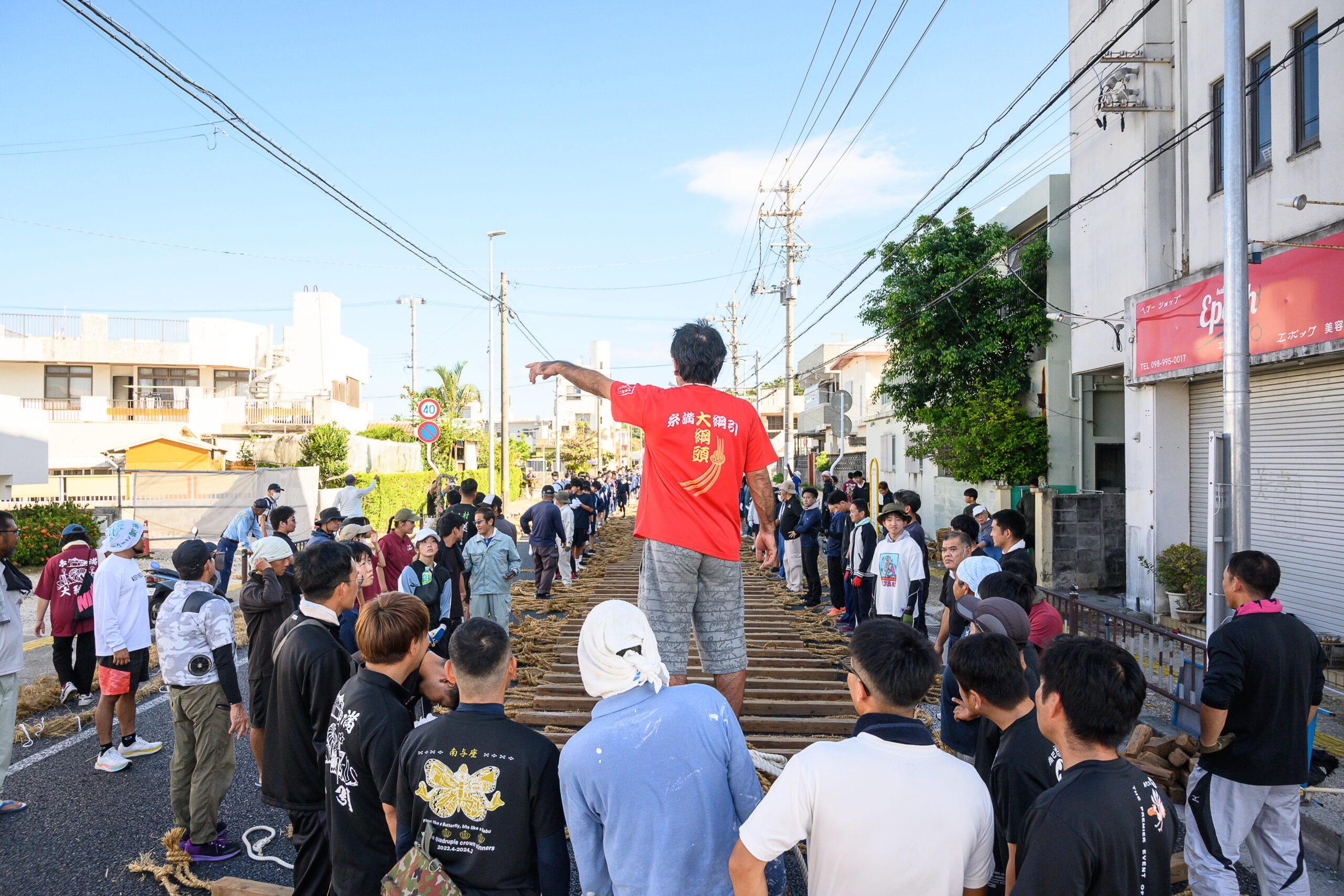
まだ一日が始まりきる前の時間に、
町はすでに動き出していた。
静けさの残る朝の空気の中で、
人の気配だけが少しずつ増えていく。
これから始まるのは、
ただの準備ではない。
糸満の町そのものが動き出し、
ひとつの大きな形をつくっていく時間だった。
本文
2025年10月6日。
糸満大綱引き当日の朝である。
この日、白銀堂から糸満ロータリーにかけての道路は通行止めとなり、
町の中心が行事の舞台となっていた。
県道256号線と国道331号線の一部が封鎖され、
道路いっぱいに人が集まり始めていた。
私は朝7時半ごろに現場に到着した。
「8時でいいよ」と聞いていたが、
すでに多くの人が作業をしていた。
最初に行われていたのは、
綱を締めるためのロープの準備だった。
各地域で作られた小綱を寄り合わせて大綱を作ったあと、
その形を保つために強く締め上げる必要がある。
そのためのロープを準備していたのだ。
私が到着したときにもすでに多くの人が作業をしていたが、
時間が経つにつれて、さらに人が増えていった。
中学生くらいの子どもたちや高校生たちも加わり、
道路の両側には人の列が伸びていく。
9時前になると、
各地域で作られた小綱が次々と運ばれてきた。
その綱が、
綱引きの舞台となる県道256号線の上に並べられていく。
ここから大綱づくりが始まる。
南方と北方に分かれ、
それぞれの側で綱を作っていく。
まずは「目綱」と呼ばれる輪の部分を作る作業から始まる。
ドラム缶を使い、
小綱をUターンさせるように重ねていく。
道路の両側には多くの人が並び、
小綱を手送りで渡していく。
綱は人の手から手へと送られ、
ドラム缶を回り込み、再び戻ってくる。
その動きを繰り返しながら、
少しずつ輪が形になっていく。
この年は六本ほどの小綱を重ねていたように見えた。
途中で小綱が切れる場面があった。
そのとき、
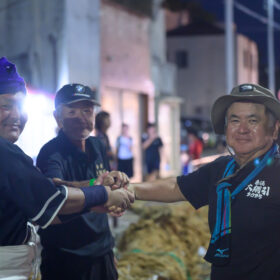
上原義隆さんが現れた。
切れた綱を手際よく結び直していく。
無駄のない動きだった。
長年にわたり毎年この行事を守ってきた人の技なのだろう。
周りの人たちもそれを当然のように見守っていた。
小綱を重ねて形ができると、
朝準備していたロープでそれを締めていく。
綱を束ね、
強く引き、
木槌のような道具で叩きながら締め上げていく。
小綱が運ばれてきたのは朝8時半ごろ。
そして大綱がほぼ形になったのは9時49分だった。
わずか一時間ほどの間に、
巨大な綱が作り上げられていく。
その太さは、
成人男性二人分の胴回りほどはあるのではないかと思うほどだった。
私は北方の綱の様子を主に見ていた。
綱が完成すると、
そこに泡盛がかけられた。
完成を祝っているのか、
あるいは勝利を願っているのか、
その意味は確認していない。
ただ、その瞬間、
どこか晴れやかな空気が流れていた。
多くの人の手によって、
短い時間の中で作り上げられていく大綱。
その光景は、
まさに町総出の作業だった。
写真

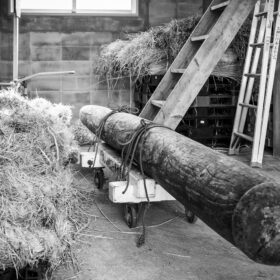
小綱を束ねまとめるためのロープを準備する少年たち。


綱頭。


こちらが雌綱の輪の中にはいる。

固くして締めていく。


(もう一方の雌ツナは横になっている)


⸻
このシリーズの他の記事はマガジンからご覧ください。
活動やプロフィールはこちら
https://yoshihiro-hirose.org
⸻
掲載している写真および文章の著作権は
すべて撮影者に帰属します。
無断転載・複製・使用はお断りしています。
なお、写真の掲載について
ご都合等の問題がございましたら、
速やかに対応いたしますので、
下記までご連絡いただけますと幸いです。
ENGLISH
Itoman Otsunahiki 2025 — Episode 5
Making the Great Rope (October 6, 2025 — Morning)
—
October 6, 2025.
The morning of the Itoman Otsunahiki.
On this day, the road from Shirogindō to the Itoman Rotary was closed to traffic, turning the center of the town into the stage for the event.
Parts of Prefectural Route 256 and National Route 331 were blocked off, and people gradually began to gather across the entire roadway.
I arrived at the site around 7:30 in the morning.
I had been told that eight o’clock would be fine, but many people were already at work.
—
The first task being carried out was preparing the ropes used to tighten the great rope.
After the smaller ropes made in each district are combined to form the great rope, they must be tightly bound to maintain their shape.
These binding ropes were being prepared in advance.
When I arrived, many people were already working, and as time passed even more people joined.
Children around middle-school age and high school students also took part, and lines of people stretched along both sides of the road.
—
Just before nine o’clock, the small ropes made in each district began arriving one after another.
They were laid out along Prefectural Route 256, which would become the stage for the tug-of-war.
This was where the making of the great rope began.
The participants divided into the north side and the south side, each group working to build their own rope.
The first step was creating the loop called the me-zuna, the eye of the rope.
Using metal drums as guides, the small ropes were layered in a U-shaped turn.
People lined both sides of the road, passing the ropes from hand to hand.
The ropes moved from one person to another, wrapped around the drum, and returned again.
Repeating this motion, the circular loop gradually took shape.
It looked as though about six small ropes were layered together that year.
—
At one point, one of the ropes snapped.
At that moment, Yoshitaka Uehara appeared.
With quick and practiced movements, he tied the broken rope back together.
There was no wasted motion.
It was likely the skill of someone who had protected and supported this event for many years.
Those around him simply watched, as if this was something entirely natural.
—
Once the ropes had been layered into shape, they were tightened using the binding ropes prepared earlier.
The ropes were bundled together, pulled tight, and struck with wooden mallets to compress and secure them.
The small ropes had begun arriving around 8:30 in the morning.
By 9:49, the great rope had almost completely taken shape.
In just about one hour, the enormous rope had been created.
Its thickness looked as though it might be as large as the combined girth of two adult men.
—
I mainly watched the rope being made on the north side.
When the rope was finished, awamori was poured over it.
I did not confirm whether it was meant to celebrate its completion or to pray for victory.
But in that moment, a bright and uplifting atmosphere spread through the crowd.
The great rope, created in such a short time by the hands of so many people, was truly a collective effort of the entire town.
—
Other articles in this series can be found in the magazine.
For activities and profile:
https://yoshihiro-hirose.org
—
All photographs and texts published here are copyrighted by the photographer.
Unauthorized reproduction, duplication, or use is strictly prohibited.
If there are any concerns regarding the publication of photographs, please feel free to contact me and I will respond promptly.
info@yoshihiro-hirose.org